
America is increasingly deeply divided over cultural, political, and moral subjects. Many issues about which there once was broad consensus—marriage and family, religion and its role in the public square, sexuality, economic order, the reach and legitimacy of government, policing, immigration, human life and dignity, foreign relations, national defense, work and leisure, arts and entertainment, education, and more—have become major “culture war” flashpoints over the past five, even ten decades, with accelerating disintegration of consensus.
Christians who pray for God’s kingdom to come and His will to be done on Earth as it is in Heaven, who are committed to making disciples of all nations by teaching them to obey all that He has commanded, who believe that God-breathed Scripture can train men, women, and children in righteousness so they are equipped for every good work, should recognize the need for the Church of Jesus Christ to speak knowledgeably, clearly, and confidently to such issues in a way genuinely shaped by Biblical worldview, theology, and ethics.
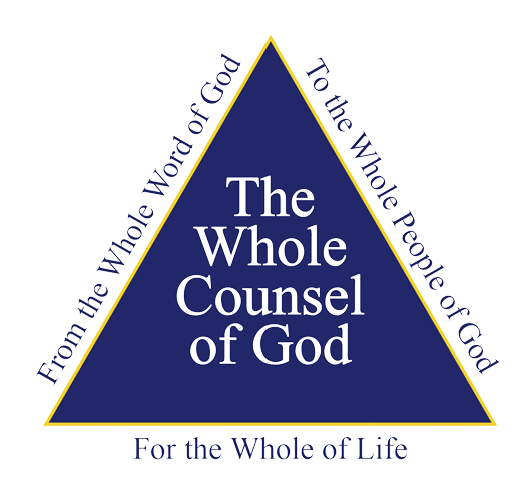
Yet few Christians are equipped to do that, primarily because they have not been taught the whole counsel of God from the whole Word of God to the whole people of God for the whole of life.
That is, they have not been taught what the Bible itself says, either explicitly or by logical implication, about most issues outside of
- the good news of individual salvation—that Christ died for their sins, was buried, and rose from the dead, truths that, taken together, are the power of God for salvation to everyone who believes because in them is revealed the righteousness from God received by faith from start to finish (1 Corinthians 15:1–3; Romans 1:16–17);
- elementary Christian doctrine—Christian theism, the Creator/creature distinction, humanity’s fall into sin, the Trinity, the virgin birth of Christ, His Deity, His sinless life, His substitutionary and atoning death, His resurrection from the dead, His ascension into Heaven, His expected return in final judgment, etc.; and
- basic Christian ethics—the Ten Commandments and their summary in the Two Great Commandments, though often with little explication, amplification, and application.
An Objection: Keep the Main Thing the Main Thing
An immediate and understandable objection is that the church must keep the gospel of individual salvation at the center. “Keep the main thing the main thing” is wise counsel. Those who preached a gospel of individual salvation by works instead of by faith, not those who taught a variant view of cultural activity, were the ones Paul condemned for preaching “another gospel” and warned that they faced God’s everlasting damnation (anathema Galatians 1:8). This makes sense, because, as C.S. Lewis said in The Weight of Glory, “Nations, cultures, arts, civilizations—these are mortal, and their life is to ours as the life of a gnat. But it is immortals whom we joke with, marry, snub, and exploit—immortal horrors or everlasting splendors.” So it is right to give the gospel of individual salvation top priority in the mission of the church.
Sad to say, however, ongoing surveys demonstrate that many professing believers are largely ignorant or confused even about the gospel of individual salvation, about both justification and personal sanctification. The church must address this, and in conjunction with it the good news of the Kingdom of God, an emphasis widely lacking in today’s churches, despite the Gospels’ repeatedly stating that Jesus Himself went about preaching “the gospel of the kingdom” and instructed His disciples to do likewise (Matthew 4:23; 9:35; 24:14; Luke 16:16; etc.). As a result, they are ill equipped to function as salt of the earth (Matthew 5:13), light of the world (Matthew 5:14–16), leaven of the Kingdom (Matthew 13:33; Luke 13:20–21), and the grain of mustard seed that grows (Matthew 13:31).
- Law
- Government
- Economics
- Business and Professions
- Education
- Arts and Media
- Medicine
- Science and Technology
- Psychology and Counseling
- Christian Unity
- Local and World Evangelism
- Discipleship
- Helping the Hurting (mercy/compassion ministries)
- Educating Christians about Social and Political Moral Issues
- Revitalizing Christian Colleges and Seminaries
- Marriage and the Family
- Pastoral Renewal
In his farewell to the Ephesian elders, the Apostle Paul spoke passionately:
You yourselves know how I lived among you the whole time from the first day that I set foot in Asia, 19 serving the Lord with all humility and with tears and with trials that happened to me through the plots of the Jews; 20 how I did not shrink from declaring to you anything that was profitable, and teaching you in public and from house to house, 21 testifying both to Jews and to Greeks of repentance toward God and of faith in our Lord Jesus Christ. ….
25And now, behold, I know that none of you among whom I have gone about proclaiming the kingdom will see my face again. 26Therefore I testify to you this day that I am innocent of the blood of all, 27for I did not shrink from declaring to you the whole counsel of God. 28Pay careful attention to yourselves and to all the flock, in which the Holy Spirit has made you overseers, to care for the church of God, which he obtained with his own blood.
(Acts 20:18–21, 25–28, ESV, emphases added)
Paul considered himself “innocent of the blood of all” not because he had preached only “Believe on the Lord Jesus Christ, and you will be saved,” which is the power of God for salvation to everyone who believes (Acts 16:31; Romans 1:16–17), but because he had also declared “anything that was profitable … the kingdom … the whole counsel of God.”
The Dutch theologian and prime minister Abraham Kuyper (1837–1920), in Our Program: A Christian Political Manifesto (1879) and his Stone Lectures (1898), used the phrase “lifeprinciple” to describe the deepest spiritual and religious motive that animates a people’s entire common life—its culture, institutions, and laws. This “lifeprinciple” makes a people a nation rather than a mere collection of individuals. Every nation lives out of some central, organizing principle (or “worldandlifeview”) before God—whether Christian, secularliberal, revolutionary, Islamic, etc.
Such a principle supplies a nation’s basic answers to questions like: Who are we? What is justice? What is authority for? What are its limits? What is the good life? A nation’s lifeprinciple gives it a distinctive way of understanding sovereignty, liberty, social order, and culture. Christian, modernist, postmodernist, secular, liberal, Marxist, revolutionary, and other life-principles yield starkly different national character and institutional patterns.
A nation’s life-principle is not just private belief; it shapes schools, family life, politics, art, economics, foreign policy—every “sphere.” As a nation’s lifeprinciple shifts (e.g., from Christian to secular), the nation’s whole institutional and cultural configuration gradually changes as well—its laws, habits, and public morals increasingly reflecting the new animating principle. The process of shifting inevitably leads to conflict among various groups, and when the shifts are comprehensive and fundamental enough, they can cause complete societal breakdown.
America is far advanced in such a shift of national life-principle. In this historic moment, it is crucially important for Christian leaders—pastors, elders, teachers, parents, and others—to be able, and consciously self-disciplined, to teach what God has revealed explicitly or implicitly in Scripture—the whole counsel of God from the whole Word of God to the whole people of God for the whole of life—about the kinds of flashpoints mentioned above, and more, as increasing politicization transforms more and more choices from private to political. Whole Counsel aims to help facilitate these Christian leaders’ working together to do this.
A Second Objection: But I’m Not an Expert
We anticipate another objection: “But I’m not an expert in economics, or just war theory, or criminal justice, or gender confusion. How can I speak to such things? I should stick to what I know: the gospel that Christ died for our sins, was buried, and rose again from the dead—the power of God for salvation. The material principle of the Reformation—justification by grace alone through faith alone in Christ alone—I can preach and teach that, not national defense, or competing theories of economics, or urban planning.” Again, we understand this. It is keeping the main thing the main thing.
But what would happen if you were to study one topic—say, economics, or criminal justice, or immigration, etc.—for 3 hours per week for 3 years (taking a couple weeks off each year)? Your 150 hours of study would be more than 3 times the credit hours in a major field required for a bachelor’s or master’s degree in most universities. That would not make you an expert, but it would enable you to address the topic with credibility. In 12 years, you could master 4 topics; in 30 years, 10.
What if all the pastors in a metropolitan area did the same and cooperated to cover many topics? For example, there are an estimated 1,500 churches in or near Memphis, TN. Even if each had just one pastor, if 10 pastors were to study one topic 3 hours per week for 3 years, and 10 other another, and so on, the result would be 150 pastors in the greater Memphis area able to speak credibly to each of 150 topics in addition to the gospel of individual salvation and sanctification.
Would that not result in church members’ being better equipped with the whole counsel of God from the whole Word of God to the whole people of God for the whole of life? Imagine if pastors in every town and city of America did likewise!
What Is To Be Done?
The aim of those who choose to collaborate in the Whole Counsel project will be to help not just pastors but all Christians in positions to instruct their brothers, sisters, and children to learn from and work with each other. Our efforts will be concentrated in four initiatives:
- Publishing: Republishing existing materials from a variety of sources and producing new materials of our own.
- Collaboration: Exhibiting and speaking at conferences of existing organizations and hosting our own national and regional meetings.
- Commentary: on website, social media, and podcast.
- New Educational Initiatives: Developing courses for formal instruction for use in Christian colleges, universities, and seminaries, and creating niche resources for churches, Christian secondary schools, and conferences.
Our approach does not rely on political power or manipulation. As Francis Schaeffer wisely taught, to achieve God’s ends, we must do things God’s way. Accordingly, the momentum of lasting reform will flow from other ordained governmental spheres, namely, families and churches. Our work will seek to strengthen these basic building blocks as we seek to disciple as extensively as God allows.
Accordingly, we will seek to unite Biblically guided Christians to work cooperatively with all who hold to the common faith passed down once and for all.
Existing Intellectual Resources
We need not build from the ground up. Some before us have already produced excellent foundational resources on which we can build. Two of those are the International Council on Biblical Inerrancy and the Coalition on Revival. Their key documents, all in the helpful, incisive form of affirmations and denials, are:
International Council on Biblical Inerrancy
Coalition on Revival (COR) sphere documents:
- Law
- Government
- Economics
- Business and Professions
- Education
- Arts and Media
- Medicine
- Science and Technology
- Psychology and Counseling
- Christian Unity
- Local and World Evangelism
- Discipleship
- Helping the Hurting (mercy/compassion ministries)
- Educating Christians about Social and Political Moral Issues
- Revitalizing Christian Colleges and Seminaries
- Marriage and the Family
- Pastoral Renewal
- 42 Articles of the Christian Worldview
Other possible topics not addressed by COR:
- Military/Defense
- Foreign Relations
- Police/Public Safety
- Immigration
- Environmental Stewardship
- Justice
- Understanding the Times
- Understanding the Faith
- Understanding the Culture
- Truth Changes Everything
A Plan to Launch Cultural Renewal
Developing Strategic Evangelicalism
We do not insist on a centralized structure. Instead, we wish to facilitate collaboration among all who operate from the same authority and long to progress toward the same goals. We gratefully lock arms with all who are already doing fine work pursuing the same ends. We also wish, humbly, to work collegially with many others to aggressively proclaim the Whole Counsel our God and Governor has revealed. We will point to fine resources already existing (such as the Turning Point Christian Worldview book series published by Crossway in the 1980s and 1990s), and, working with others, seek to develop new ones to bring believers together to disciple the next generations, holding forth the word of life (Philippians 2:15–16) in a world that has lost many of its moorings. Unless the Lord builds the house, vain is our labor; thus, we look to the Lord of Might to bless the work of our hands.
Toward this end, we propose a series of formational meetings in the first half of 2026 to form working leadership groups consisting of capable leaders who can embrace the Whole Counsel vision, pass it on to others, and begin the work of creating new discipleship resources to turn vision into reality, with an ever-growing network of likeminded believers. We are ready to move ahead and invite your prayers, participation, and assistance in spreading the word.