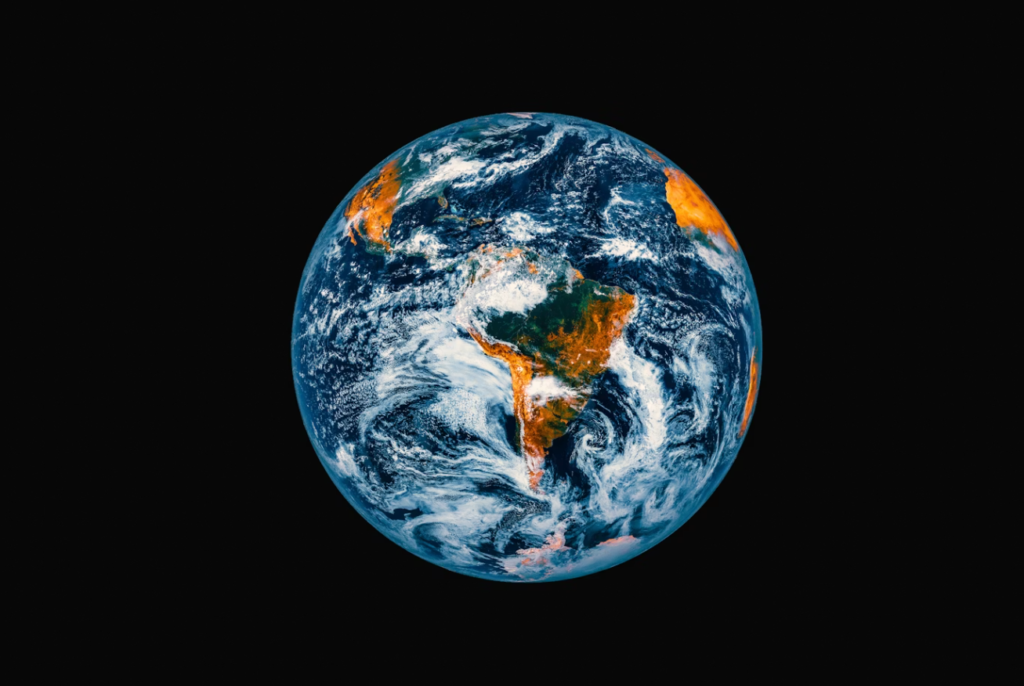
Religion is the root of any culture, and environmentalism has become a full-fledged religion in its own right. It is the most comprehensive substitute in the world today for Christianity so far as world view, theology, ethics, politics, economics, and science are concerned, and you need to understand it in order to counter it effectively, from presuppositions to policies, from classroom to movie theater, from evening network news to Internet and local newspaper.
And because environmentalism—the word coming from French meaning “surroundings,” that is, “everything,” and so meaning literally “everythingism”—is inherently totalitarian, demanding to define and control every aspect of life, it aims to control our entire political and legal structure, and indeed has already advanced far in that direction over the last half century. You, as an individual, have an important role to play in the church’s battle against it, with its alternative world view; its substitute doctrines of God, creation, humanity, sin, and salvation; and its lethal mix of bogus science and Marxist economics that threaten to fulfill the radical environmentalists’ and deep ecologists’ dream of ending industrial society and forcing humanity back into a primitive lifestyle—in which, as Thomas Hobbes put it, life was solitary, poor, nasty, brutish, and short.
The Environmentalist World View
Environmentalism is a complete alternative world view from that revealed in the Bible, the world view that has blessed Western Civilization for nearly the last 2,000 years, enabling it to make incomparable advances in philosophy, politics, science, technology, economics, the arts, and every walk of life. Its view of God, creation, humanity, sin, and salvation contrasts with those of Biblical Christianity, and that world view underlies climate alarmism.
To prevent confusion, it is important to contrast “secular environmentalism” with “religious environmentalism.” This is not because “secular environmentalism” is non-religious. It is religious to the core. But it claims to be non-religious and generally either denies or counts as irrelevant the existence of God, gods, or a spiritual realm. That is, secular environmentalism is the religion of naturalistic secularism applied to environmentalism. Religious environmentalism is any other religion applied to environmentalism.
Environmentalism’s Views of God, the World, and Humanity
The dominant doctrines of God in environmentalism are atheism (belief that there is no God), pantheism (belief that God is everything), panentheism (belief that God indwells everything as the soul does the body), and animism or spiritism (belief that every material thing, not just human bodies, is indwelt by a soul or spirit). Ironically, the atheism of secular environmentalism and the pantheism and panentheism of much religious environmentalism amount to essentially the same thing. If there is no personal Creator distinct from the universe, who created the universe out of nothing, then the universe effectively takes God’s place, since it turns out to be the Supreme Being. Animism and spiritism turn out to be little different from panentheism, for while it asserts that god indwells everything, they assert that gods—souls or spirits—indwell everything.
Consequently, for both secular and religious environmentalism, every part of the universe—what we Christians call “creation”—is part of god, and it becomes impossible to distinguish sacred and holy from secular and profane—the latter word coming from the Latin profanum, meaning before (i.e., outside) the temple. Consequently, environmentalism, both secular and religious, tends to define all the Earth and all its inhabitants as sacred and holy. From that it tends to infer that everything has intrinsic worth, not dependent on human valuation, and particularly that, as Deep Ecology founder Arne Naess put it, all life is fundamentally one, and so “biological egalitarianism” is the preferred ethic—from which thinking flow thoughts of animal rights, plant rights, and ecosystem rights, all ideas that became enshrined in the constitutions of Switzerland (where one must harvest a wheat field only in a manner that honors the dignity of the wheat) and Bolivia. While Biblical Christianity certainly affirms that mankind is answerable to God for its handling of the Earth and its inhabitants, it is difficult indeed to figure how non-rational beings can have any rights at all, since rights entail duties but non-rational things cannot have duties since they have no awareness of them, and even more difficult to figure how they might bring cases to enforce their rights, since of course they cannot know if their rights have been violated and cannot communicate what remedies they desire.
It also follows from all of this that humanity has no special, privileged position relative to other living things, or even, for some radical environmentalists, relative to non-living things. We therefore owe humane treatment to animals. But, we being not fundamentally different from animals, “humane treatment of beasts” means nothing fundamentally different from “beastly treatment of humans”—a consequence reflected in environmentalists’ general disdain for human population growth and conviction that the world is overpopulated and would be much better off with perhaps 5 or 10 percent of our present population, or perhaps even none of us. Hence British Prince Phillip’s statement that, out of concern for the environment, he would like to be reincarnated—and he believed in reincarnation—as a killer virus to reduce human population to a more reasonable level.
Environmentalists as a whole (though not all individual environmentalists) are so hostile to humanity primarily because they think people are a threat to the natural world, which they see as best untouched by human hands. “Nature knows best,” they insist—forgetting entirely that according to their world view we are part of, and indeed nothing more than part of, nature. Sin, for environmentalists, is interfering with nature, say, for example, by subduing and ruling it—which according to Genesis 1:28 God commanded us to do—which suggests that “sin is lawfulness,” the exact opposite of the Bible’s definition of sin as lawlessness (1 John 3:4).
Environmentalist Ethics and Politics
And what will save us from our sins against nature? What is the environmentalist gospel? The reordering of our lives by environmentalists, who by some stroke of luck (for there is no personal God to credit) have somehow been exempted from the flawed character that afflicts the rest of us. They are both knowledgeable and virtuous enough to be entrusted with authority:
- to determine whether we’ll drive the large, safe cars we prefer or the small, dangerous cars they prefer, or rather whether we’ll drive cars at all or use only public transportation or bicycles to get around in our “15-minute cities”;
- to decide the temperature at which to set our thermostats and the kinds of light bulbs we’ll use and how much insulation we’ll have in our homes;
- to dictate whether we’ll use disposable or cloth diapers, and plastic or cloth grocery bags, and inexpensive nuclear or fossil fuel or expensive wind or solar energy;
- to rule whether we’ll eat non-organic or organic foods, meat or vegetables, a wide variety of delightful and healthful foods grown around the world and transported to us or a narrow variety grown locally;
- and whether and how many children we’ll have.
All of these decisions, of course, will be based on the common-sense principle of sustainability. We must live according to this fundamental ethical maxim: Our way of life must be one that every generation of our descendants can have, too.
That this principle doesn’t seem to be reflected in human history is of no concern. Neither is the fac that, had our ancestors embraced this principle, we would all still be living at the level of subsistence agriculture, lacking all the benefits of industrialization, including tripled life expectancy and greatly improved health during all those extra years of life. What does it matter that the 18th-century ancestors of today’s Scots burned so much peat per person for fuel that its supply can’t possibly have lasted for consumption at the same rate by their descendants three centuries later, or that 19th-century Britons and Americans and Scandinavians and Japanese consumed whale oil in such prodigious quantities per person that its supply can’t possibly have lasted at that rate for their descendants even just a single generation later, or that practically all societies up to two centuries ago consumed so much wood per person for fuel that its supply can’t possibly have lasted for consumption at the same rate by their descendants today? According to the environmentalists’ principle of “sustainability,” we must ration energy sources like coal, oil, and natural gas to ensure that our descendants three centuries from now (regardless what technological breakthroughs might occur before then, making today’s energy sources as obsolete as peat and whale oil), and three centuries from then, and so ad infinitum, will still be able to consume them at the same rate, and at the same prices, we do.
This we must do—pardon all the sarcasm that follows!—despite the fact that our descendants a hundred years from now will be ten times wealthier than we are and thus better able to afford the alternative energy technologies the environmentalists demand we switch to now—thus effecting a redistribution of wealth from the poorer people of the present to the richer people of the future (unless, of course, our immediate shift to those more expensive fuels stops economic development and leaves them worse off than we are, which would surely please serious Greens but doesn’t seem to be the point they’re using to sell sustainability to the unwitting public). We must certainly not assume technological change will continue in the future as it has done in the past—or faster—making our present energy sources obsolete, as they did our ancestors’ peat and whale oil and wood. No, we must assume that our descendants a thousand years from now will be using the same technologies we do, that human ingenuity has reached its end with our generation—except, of course, that we will generate technological innovations overnight to make the instant switch to renewables easily affordable, which is why of course no sane person fears that legally mandated shifts from inexpensive fossil fuels to renewable biofuels, wind, and solar will be physically unworkable and economically devastating.
Environmentalist Thought: The Flight from Reason to Mysticism
If you’re beginning to get the sense that there’s something fishy about environmentalists’ thought processes, you’re right. Environmentalism, as Dr. Vishal Mangalwadi points out in his YouTube series “Wisdom from India: Lecture 6, Ecology,” is in mad flight from reason to mysticism. Rejecting the divine Logos revealed to us in Scripture and the incarnate Son of God, the Logos that lightens everyone who comes into the world (John 1:9), environmentalism seeks knowledge from mystical, intuitive interaction with nature. Thus, “One itinerant environmentalist conducts ‘workshops’ in which participants are urged to remember their alleged evolutionary history by rolling on the ground and imagining what their lives were like as dead leaves, slugs, and lichens” (Bidinotto, 1989). And Arne Naess, one of the chief framers of the Deep Ecology worldview and the coiner of the phrase deep ecology, specified that his work consists not “of philosophical or logical argumentation” but is “primarily intuitions” (Eisenberg, 1990). Naess apparently thinks so little of human beings that he doesn’t care whether there are a hundred million or a billion of them, since elsewhere he suggests an ideal population of a billion (Borrelli, 1988).
The focus on intuition in the Deep Ecology movement explains, in part, why feminism allies itself with environmentalism, particularly with Deep Ecology and animal rights. Feminism rejects science outright—or redefines it—because science operates in a manner not sufficiently sensitive to “feminine thought patterns” because it is a fundamentally “masculine” discipline. “Science’s insistence on being tough, rigorous, rational, impersonal, and unemotional is intertwined with men’s gender identities,” says feminist theologian and animal rights theorist Carol Adams, author of The Sexual Politics of Meat: A Feminist-Vegetarian Critical Theory.
The irrationality of environmentalist thought has even been formalized. Taking their cue from postmodernism, with its relativism and deconstructionism, which sees communication not as conveying truth but as exerting power, many leading environmentalists, especially some at the center of global warming alarmism, have embraced “post-normal science,” a practice first defined and promoted in the 1960s primarily by philosophers of science Jerome Ravetz and Silvio Funtowicz. (It’s no coincidence, by the way, that, according to the Wikipedia article on him, “Ravetz grew up in a left-wing family and although never a member of the American Communist Party he was what was then called a fellow traveler.”)
The Dangerous Phenomenon of Post-normal Science
It’s important to understand post-normal science, for it underlies many of the public controversies now raging about various environmental claims—especially about allegedly dangerous manmade global warming.
In his 1964 book The Character of Physical Law, Nobel Prize-winning physicist Richard Feynman summarized scientific method famously:
In general we look for a new law by the following process. First we guess it. Then we compute the consequences of the guess to see what would be implied if this law that we guessed is right. Then we compare the result of the computation to nature, with experiment or experience, compare it directly with observation, to see if it works. If it disagrees with experiment it is wrong. In that simple statement is the key to science [emphasis added]. It does not make any difference how beautiful your guess is. It does not make any difference how smart you are, who made the guess, or what his name is—if it disagrees with experiment it is wrong. That is all there is to it.
Feynman’s “key to science” is in full agreement with the Apostle Paul’s admonition in 1 Thessalonians 5:21 to “test all things, hold fast what is good.”
But post-normal science is a veritable revolution against scientific method so understood. Eva Kunseler (2007), a proponent of post-normal science, defined “normal science” this way:
[Normal] Science is a logic inductive process leading to theory formulation, while all the way put through critical tests that have been deductively derived from the theory; [philosopher of science Karl] Popper’s critical rationalist concept of science is an objective progression toward the truth. … The term normal science refers to the routine work of scientists within a paradigm; slowly accumulating knowledge in accord with established theoretical assumptions. … The paradigm is enlarged and frontiers of knowledge and techniques pushed forward. The exercise of scholarly activities is defined by the dominance of the Mertonian [named for philosopher of science Robert K. Merton] CUDOS [C-U-D-OS] norms of science. They include:
(C)ommunalism—the common ownership of scientific discoveries, according to which scientists give up intellectual property rights in exchange for recognition and esteem;
(U)niversalism—according to which claims to truth are evaluated in terms of universal or value-free criteria;
(D)isinterestedness—according to which scientists are rewarded for acting in ways that appear to be selfless;
(O)rganized (S)kepticism—all ideas must be tested and are subject to structured community scrutiny.
“Organized skepticism” amounts to what Feynman called “the key to science.” Every guess, every hypothesis, every theory, must be tested by comparing predictions based on it with empirical observations in the real world, whether out in nature or in the laboratory. And it is not enough that the theory’s author test it—other scientists must test it, too, which entails, as the philosopher of science Robert K. Merton (1938) put it, that “science makes skepticism a virtue.” With that understanding, “climate-change skepticism” should be a title of honor, not a term of opprobrium.
But Kunseler, turning from what she had called “normal science,” then described post-normal science:
The concept of post-normal science goes beyond the traditional assumptions that science is both certain and value-free . … The exercise of scholarly activities is defined by the dominance of goal orientation [emphasis added] where scientific goals are controlled by political or societal actors . … Scientists’ integrity lies not in disinterestedness but in their behavior as stakeholders. Normal science made the world believe that scientists should and could provide certain, objective factual information. … The guiding principle of normal science—the goal of achievement of factual knowledge—must be modified to fit the post-normal principle. … For this purpose, post-normal scientists should be capable of establishing extended peer communities and allow for ‘extended facts’ from non-scientific experts . … In post-normal science, the maintenance and enhancement of quality, rather than the establishment of factual knowledge, is the key task of scientists . … Involved social actors must agree on the definition of perceptions, narratives, interpretation of models, data and indicators . … scientists have to contribute to society by learning as quickly as possible about different perceptions … instead of seeking deep ultimate knowledge.
Leading alarmist climate-change “scientists” fling “climate-change skeptic” and “global warming skeptic” at scientists who dare question their claims as epithets of scorn. But they know exactly what they’re doing—post-normal science, not real science.
Post-normal science was on brilliant display in “Climategate,” the release of thousands of emails, computer codes, and other documents among leading climate alarmist scientists centered on the Climatic Research Unit at the University of East Anglia. The emails revealed that alarmist climate scientists were fabricating, exaggerating, cherry picking, and suppressing data, intimidating dissenting scientists, blackballing journal editors willing to publish the dissenters, corrupting the peer review process, refusing to share data and code with fellow scientists on request even when required to by the journals in which they published, and violating American and British Freedom of Information Acts. (For the best discussion of Climategate and critique of the whitewashing official inquiries into it, see environmental economist Dr. Ross R. McKitrick’s posts at https://www.rossmckitrick.com/climategate.html.) Climategate contributed considerably to the decline in public belief in dangerous manmade global warming.
Mike Hulme, author of Why We Disagree About Climate Change: Understanding Controversy, Inaction, and Opportunity (2009), founding director of the Tyndall Centre and, when the book was published, Professor of Climate Change at the University of East Anglia, home of the Climatic Research Unit, prepared climate-change scenarios and reports for the British government, the European Commission, the United Nations Environment Program, the United Nations Population Division, the Intergovernmental Panel on Climate Change (IPCC) (as a lead author for the chapter on “Climate scenario development” for the 2001 Assessment Report and a contributing author on several other chapters), and the World Wildlife Fund, recognized post-normal science as at the foundation of climate-change science. He cannot be written off as a fringe climate scientist. British Christian blogger Kevin McGrane (2009) cited Hulme for the fact that the science of climate change is an instance of “post-normal” science:
Climate change seems to fall in this category. … The IPCC is a classic example of a post-normal scientific activity.
Within a capitalist world order, climate change is actually a convenient phenomenon to come along.
The danger of a “normal” reading of science is that it assumes science can first find truth, then speak truth to power, and that truth-based policy will then follow. … exchanges often reduce to ones about scientific truth rather than about values, perspectives and political preferences.
… “self-evidently” dangerous climate change will not emerge from a normal scientific process of truth-seeking. … [S]cientists—and politicians—must trade truth for influence. What matters about climate change is not whether we can predict the future with some desired level of certainty and accuracy. …
The function of climate change I suggest, is not as a lower-case environmental phenomenon to be solved. … It really is not about stopping climate chaos. Instead, we need to see how we can use the idea of climate change—the matrix of ecological functions, power relationships, cultural discourses and materials flows that climate change reveals—to rethink how we take forward our political, social, economic and personal projects over the decades to come.
Climate change also teaches us to rethink what we really want for ourselves. … [M]ythical ways of thinking about climate change reflect back to us truths about the human condition. … The idea of climate change should be seen as an intellectual resource around which our collective and personal identifies and projects can form and take shape. We need to ask not what we can do for climate change, but to ask what climate change can do for us. … Because the idea of climate change is so plastic, it can be deployed across many of our human projects and can serve many of our psychological, ethical, and spiritual needs.
… climate change has become an idea that now travels well beyond its origins in the natural sciences. … climate change takes on new meanings and serves new purposes. …. climate change has become “the mother of all issues,” the key narrative within which all environmental politics—from global to local—is now framed. … Rather than asking “how do we solve climate change?” we need to turn the question around and ask: “how does the idea of climate change alter the way we arrive at and achieve our personal aspirations …?”
In other words, “post-normal science,” shorn of the commitments of normal science to transparency, disinterestedness, falsifiability, and skepticism, is the guise under which climate change and any other issue can become the vehicle for promoting predetermined social and political goals, all the while pretending to be “just science,” not, as it truly is, a political ideology.
It does this partly by promoting what Hulme calls “Four Myths” common to environmentalism:
- Lamenting Eden,
- Presaging Apocalypse,
- Reconstructing Babel (promoting technology as the solution to all problems), and
- Celebrating Jubilee.
Don’t let Hulme’s calling these “myths” mislead you. He doesn’t mean to denigrate them as false. He means to highlight their culture-shaping power, whether true or false. Lamenting Eden is the tendency of environmentalists to hark back to a golden age, an age before humanity transgressed its bounds and began to harm the perfect paradise that was Earth. Presaging Apocalypse is their tendency to look forward—sometimes with fear, sometimes with ghoulish delight—to the time when the offended Gaia will take its revenge on humanity through ecological collapse. Reconstructing Babel is what environmentalists accuse humanity of doing through the development of technology and urbanization. And Celebrating Jubilee is their pursuit of “ecojustice” (codespeak for wealth redistribution to achieve the equality of wealth that all people are due).
It is immediately clear that these are all religious elements, reflecting, but twisting, the Biblical heritage, right down to the mistaken appeal to the Jubilee (which in Leviticus 25 did not require redistribution of wealth but the return of what was effectively productive collateral for a loan when it was paid off; Beisner, 1990). It is important to note that Hulme identifies these religious ideas as characteristic of environmental science, not environmental politics, sociology, or religion. I could analyze and refute each from a Biblical, Christian perspective, but for brevity’s sake let it suffice to recognize that at the root of environmentalists’ migration from science to pseudo-religion is its commitment to post-normal science. It is a philosophically sophisticated epistemological construct and must not be underestimated. Until we understand its pervasive influence in the climate alarmist community, climate realists and climate alarmists will continue talking past each other, and the “debate” over the “science” of climate change will continue to be characterized by thoroughly unscientific (because irrational) tactics such as
- demonization of dissent (the logical fallacy of ad hominem abusive, attacking the person),
- distrust of attempts at replication,
- rejection of openness and data sharing (both the logical fallacy of petitio principii, begging the question), and
- appeal to consensus (the logical fallacy of argumentum ad populum).
Climategate and ensuing transgressions of logic and fundamental scientific procedure by global warming alarmists make it increasingly clear that a great deal of what’s been called “climate science” isn’t science at all. It’s ideological propaganda, often religious (but certainly not Biblical), masquerading as science.
The warfare between post-normal science and real science is important not just in the debate over “climate change,” but in all kinds of issues in which science interfaces with policy (like transgenderism and “gender-affirming care,” whether there is a genetic basis to homosexuality, and official responses to the COVID-19 pandemic). If real scientists don’t rise up and point out that this emperor has no clothes, the whole scientific enterprise will die. And the world will be a poorer place for it.
Like the pseudo-Christian cults that borrow vocabulary from Christianity but redefine all the terms, post-normal science is simply the application of rhetoric borrowed from the sciences to policy debates, cloaking one particular policy preference with the authority of “science,” and successful at doing so only to the extent that policy makers and the public are ignorant of the fact that post-normal science isn’t science at all. In the final analysis it is no different from what physicist Richard Feynman (1974) called “cargo cult science,” that is, “work that has the semblance of being scientific, but is missing ‘a kind of scientific integrity, a principle of scientific thought that corresponds to a kind of utter honesty.’”
This foray into the unmaking of science by post-normal science concludes this rather quick sketch of the environmentalist world view and its view of God, creation, humanity, sin, and salvation. Now consider the Biblical, Christian understanding in contrast.
The Biblical World View: God, Creation, Humanity, Sin, Salvation, and Ethics
For Biblical Christianity, God is the infinite, eternal, and unchangeable personal Spirit:
- who created all other things out of nothing (Hebrews 11:3) and man in His image (Genesis 1:26–28), all for His own glory (Psalm 19:1–6; Revelation 4:11; Ephesians 1:11–12);
- who by making man in His image, equipping him with logos, the “light that lightens everyone who comes into the world” (John 1:9), set him apart from all the rest of nature by making him—not mountains or oceans or plants or animals or microbes—capable of reason;
- who stipulated that man should, and would, multiply, fill the Earth, subdue it, and rule over it as His representative and steward (Genesis 1:28);
- whose Logos not only is the Light that lightens everyone who comes into the world (John 1:1, 9) but also instilled order into creation that reflects the orderliness of His mind and so can be understood and controlled for their benefit by those who bear His image (Proverbs 8:22–36);
- who on completing His creation declared it all “very good” (Genesis 1:31);
- who judged all mankind in the person of its covenant head, Adam, for Adam’s disobedience (Romans 5:12–19), cursed the ground over which He had given Adam authority (Genesis 3:17–19), and yet also provided an atonement for sin for all who trust in His promised Anointed One (Genesis 3:21; John 1:29);
- who promised to sustain His Earth and all its cycles on which life depends by His own power (Genesis 8:22) until the Day when He will judge all mankind by His law, a law written not only on stones at Sinai but also in the heart of every man, and by His gospel (Acts 17:30–31; Romans 2:16; Revelation 20:11–15);
- who revealed that gospel first in His warning to Satan in the Garden of Eden that the Seed of the woman would crush his head (Genesis 3:15), and then again and again through His covenant promises to Adam and Eve, to Noah, to Abraham, Isaac, and Jacob, to Moses and the people of Israel at the exodus and again on their entry to the Promised Land with Joshua, to David and Solomon, and ultimately “in these last days . . . in His Son, whom He appointed heir of all things, through whom also He made the world” (Hebrews 1:1–2).
Neither Earth nor the whole universe is God, or (as feminist eco-theologian Sally McFague (1993) thinks), the body of God. Nature not only doesn’t know best; nature doesn’t know—anything. Earth is not best untouched by human hands but subdued and ruled by them—particularly when those human hands are guided by rational thought based on Biblical world view, theology, and ethics. Land and seas, lakes and rivers, mountains and prairies, forests and wetlands, coral reefs and deep ocean trenches, mammals and reptiles and amphibians and fish and birds, all these things are wonderful, but they are not all equal, and none of them is equal to men and women, boys and girls, who alone are the image and glory of God. Charged by environmentalists with anthropocentrism—as if there were something obviously wrong with that—Christians respond by embracing, but clarifying, the charge: Yes, we are anthropocentric, but an even deeper center is God Himself, who made all things for Himself. We recognize concentric circles of priority: God at the very center, human beings next, sentient life next, non-sentient life next, and nonliving things next. Reminded that the “Earth is Jahweh’s, and all it contains” (Psalm 24:1), we say “Amen” and add what God said through another psalmist: “The heavens are the heavens of Jahweh, but the Earth He has given to the sons of men” (Psalm 115:16).
We find our ethics spelled out in God’s moral law, written by His own finger on the tablets at Sinai (Deuteronomy 4:13) and on the heart of every man (Romans 2:14–15). We define sin not by the shifting standards of cultural and scientific relativism but by the law of God, for “sin is lawlessness” (1 John 3:4). And we find salvation not in recycling or buying carbon offsets (the indulgences of our day) but in trusting Christ, and Him alone, and thus having our sins imputed to Him and His righteousness imputed to us (Romans 3:19–28; 4:1–8).
As God’s representatives charged to subdue and rule the Earth and everything in it (Genesis 1:28), we recognize that we are accountable to our Creator and Lord, and that our subduing and ruling should reflect His creative work recorded in Genesis 1:1–25. Displaying His wisdom and righteousness and holiness, God started with nothing and made everything; He started with darkness and made light; He started with disorder and made order; He started without life and made life, in glorious abundance, and instructed every variety of it to multiply and fill its niche in the Earth. Mankind, then, made in God’s image, blessed, and instructed to “multiply and fill the Earth and subdue it and have dominion over” everything in it (Genesis 1:28), should reflect God’s own actions by making more and more out of less and less (improving efficiency in the use of resources), advancing in knowledge and its application to the surrounding world, bringing greater order out of lesser order, and enhancing life, especially human life, on a planet whose fruitfulness, beauty, and safety he is intent on enhancing. Dominion is no license for abuse, but neither is stewardship a barrier to lawful use—lawful being defined, as we have said in The Cornwall Declaration on Environmental Stewardship, not by environmentalists’ whims but by God’s moral revelation in the Ten Commandments and their amplification throughout Scripture.
Indeed, taking note of the difference between the Garden of Eden, a specific and restricted locale in which God put Adam and told Him to cultivate and guard it (Genesis 2:1–15) and the rest of the Earth, outside the Garden, which He told Adam and Eve to fill, subdue, and rule (Genesis 1:28), and, taking seriously also God’s curse on the ground and His expulsion of our first parents from the Garden, we recognize that after the Fall and the Curse our original mandate to cultivate and guard the Garden and to subdue and rule the Earth continues, with this clarification: that we are, by subduing and ruling, to be bringing more and more of the Earth into greater and greater similarity to the Garden, knowing all along that perfection will come only with the New Heaven and New Earth brought in by the return of Christ to receive His perfected Bride, the Church, when “He will wipe away every tear from their eyes, and there will no longer be any death; there will no longer be any mourning, or crying, or pain,” for “He who sits on the throne [says], ‘Behold, I am making all things new’” (Revelation 21:1–5).
We reject the over-realized eschatology of utopianism that thinks we can achieve perfection now (for example, by being able to drill for oil or mine for coal, or build wind turbines or solar arrays, with zero risk of accidents). Neither do we embrace the view that because God will eventually judge this world and make the New Heaven and New Earth, we are free to abuse the present Earth now. We are answerable to Him for how we use it. We recognize that we shall never live in a risk-free world. But we embrace the freedom, and the responsibility, to use the Earth and all that is in it for God’s glory and mankind’s benefit, and we believe that so far as we fulfill the Great Commission to make disciples of all nations and teach them to obey all that God has commanded we will thereby enhance mankind’s ability to fulfill the Dominion Commission to subdue and rule the Earth.
In light of these and other Biblical teachings, as the The Cornwall Declaration on Environmental Stewardship puts it, we aspire to a world in which
- Human beings care wisely and humbly for all creatures, first and foremost for their fellow human beings, recognizing their proper place in the created order.
- Objective moral principles—not personal prejudices—guide moral action.
- Right reason (including sound theology and the careful use of scientific methods) guides the stewardship of human and ecological relationships.
- Liberty as a condition of moral action is preferred over government-initiated management of the environment as a means to common goals.
- The relationships between stewardship and private property are fully appreciated, allowing people’s natural incentive to care for their own property to reduce the need for collective ownership and control of resources and enterprises, and in which collective action, when deemed necessary, takes place at the most local level possible.
- Widespread economic freedom—which is integral to private, market economies—makes sound ecological stewardship available to ever greater numbers.
- Advancements in agriculture, industry, and commerce not only minimize pollution and transform most waste products into efficiently used resources but also improve the material conditions of life for people everywhere.
None of these aspirations can be fulfilled, however, apart from the gospel of Jesus Christ, whose righteous life and sacrificial death reconcile to God all who trust in Him, and who renews the minds of believers to understand God’s Word and God’s world, enabling them to become good stewards of God’s abundant gifts. To that end, we commit ourselves to the two great mandates of Scripture: the Dominion Mandate of Genesis 1:28 to multiply and fill the Earth and to subdue and rule over it, enhancing its fruitfulness, beauty, and safety to the glory of God and the benefit of our neighbors, and the Great Commission of Matthew 28:19 to make disciples of all nations, teaching them to obey all that God has commanded.
References
Adams, Carol. The Sexual Politics of Meat: A Feminist-Vegetarian Critical Theory (Bartlett, 1990).
Bartlett, K. (1990). “Of Meat and Men: A Conversation with Carol Adams,” The Animals’ Agenda (October).
Beisner, E. Calvin. (1990). Prosperity and Poverty: The Compassionate Use of Resources in a World of Scarcity.
Borrelli, P. (1988). “The Ecophilosophers,” The Amicus Journal (Spring).
Eisenberg, E. (1990). “The Call of the Wild,” New Republic (April 30).
Feynman, Richard P. (1964). The Character of Physical Law. (London: British Broadcasting Corporation.)
Bidinotto, J. (1989). “Environmentalism: Freedom’s Foe for the ’90s,” The Freeman 40:11 (November), 409–420.
Feynman, Richard P. (1974). “Cargo Cult Science.” Commencement address, CalTech, 1974. Accessed online July 29, 2025, at https://calteches.library.caltech.edu/51/2/CargoCult.htm.
Hulme, Mike. (2009). Why We Disagree About Climate Change: Understanding Controversy, Inaction, and Opportunity, 4th ed. (Cambridge: Cambridge University Press).
Kunseler, Eva. (2007). “Towards a new paradigm of science.” Accessed July 29, 2025, at https://www.nusap.net/downloads/KunselerEssay2007.pdf.
Mangalwadi, Vishal. “Wisdom from India: Lecture 6, Ecology,” 2021. Accessed July 29, 2025, at https://www.youtube.com/watch?v=YXg8UdoDcLA&list=PL9cJRl8EYnLfJiCKxYJb9wIDU8vL8NeuJ&index=6.
McFague, Sally. (1993). The Body of God: An Ecological Theology. (Minneapolis: Fortress Press.)
[McGrane, Kevin.] (2009. “Climate Change and the Death of Science,” Buy the Truth. Accessed July 29, 2025, at https://buythetruth.wordpress.com/2009/10/31/climate-change-and-the-death-of-science/.
Merton, Robert K. (1938). “Science and the Social Order,” Philosophy of Science 5:3 (July 1938), 321-337, at 334.
Mosher, Steven, and Thomas W. Fuller, Climategate: The Crutape Letters. Createspace, 2010.
Wikipedia (n.d.). “Jerome Ravetz.” Online at https://en.wikipedia.org/wiki/Jerome_Ravetz.