A little while back, I did a podcast on the greenhouse effect. It seems that the most controversial thing I have ever said is “Carbon Dioxide contributes very little to the Greenhouse Effect.” That singular statement usually gets me labelled as either a scientific illiterate or a stooge of climate alarmists. And those are the milder accusations that are usually hurled at me. So, at the risk of inflaming more people, I will reluctantly attempt to explain this again.
Trigger alert: I am about to say things that are likely to raise the ire of some of my readers. I do not do this intentionally, and if you are prone to fits of rage, maybe you should pass on this article … and maybe seek professional help. (Just kidding.) But I have talked with other climatologists with whom I am still conversant, and they too have battled these types of discussions over the years. Since it has come up again recently, I will explain my point of view again.
Here is the controversial statement: “Carbon Dioxide contributes very little to the Greenhouse Effect.”
First, that simple proclamation raises the temperature of most climate alarmists to a boiling… er, maybe I should call it … a tipping point.
Carbon dioxide has been labeled an Earth-breaking, existential threat and merely by increasing its concentration to about 427 parts per million, we have committed the Earth to a warming of at least one-and-a-half degrees Celsius. The recent Dartington Declaration, signed by more than five-hundred PhDs, argues that this small increase in carbon dioxide has condemned the coral reefs to an extensive dieback if not outright extinction and put the rest of the planet in peril. Their arguments are that we must reduce global anthropogenic greenhouse gas emissions by one half by 2030 and reach net zero by 2050.
If the UN Conference of Parties cannot seem to reduce carbon dioxide emissions after thirty meetings, I am not sure how signatures from five hundred scientists will make any difference, especially if they ignore the development of China and India, but I digress. The question here is always “How much warming will a doubling of carbon dioxide cause, and will that warming be devastating to the planet?”
I can cite numerous scientific studies that demonstrate a doubling of atmospheric carbon dioxide will warm the planet between 1.0 and1.5 degrees Celsius. The argument that a magical tipping point in climate disasters occurs with a warming of just 1.5 degrees Celsius is a political statement and arises not from a scientific argument that a sharp cliff exists at exactly 1.5 degrees Celsius. It goes back to COP16 in Cancun, which formally suggested a need to “consider strengthening the long-term goal from two degrees Celsius to one-point-five.”
As I often say, carbon dioxide is but a bit player in climate change. But yes, it does get listed in the credits because it plays a role, albeit small.
Having gored the first ox, I will now turn my attention to the second: the concept that the greenhouse effect is non-existent. There are several arguments for this, including (1) that no molecule can store heat, (2) that climatologists are idiots who cannot understand the basics of physics, and (3) that a century-and-a-half old conspiracy theory was perpetrated by famous physicists to guarantee that the concept of global warming could be used to destroy our way of life.
Let me take these on one at a time.
The first argument is what I call the “instantaneous re-radiation model”; that is, any object or molecule, upon absorbing a photon of electromagnetic radiation, has five femtoseconds to emit that energy in other wavelengths of electromagnetic radiation. Thus it cannot be said to store heat.
My immediate response to this line of thought is to ask those who follow it, “How do you define the temperature of an object?” When I learned physics, it was defined as “the intensive variable that determines the direction of spontaneous heat flow and quantifies the average kinetic energy per-particle in thermal equilibrium.”
That is just a fancy way of saying that “temperature is the measure of the average kinetic energy of the molecules that makes up the object.”
How does an object obtain an increase in kinetic energy when it warms? One way is to absorb more electromagnetic energy than it gives off. Yes, it must give off energy if its temperature is above absolute zero, but if more energy is obtained than is given off, the kinetic energy increases, and subsequently, the temperature of the object increases.
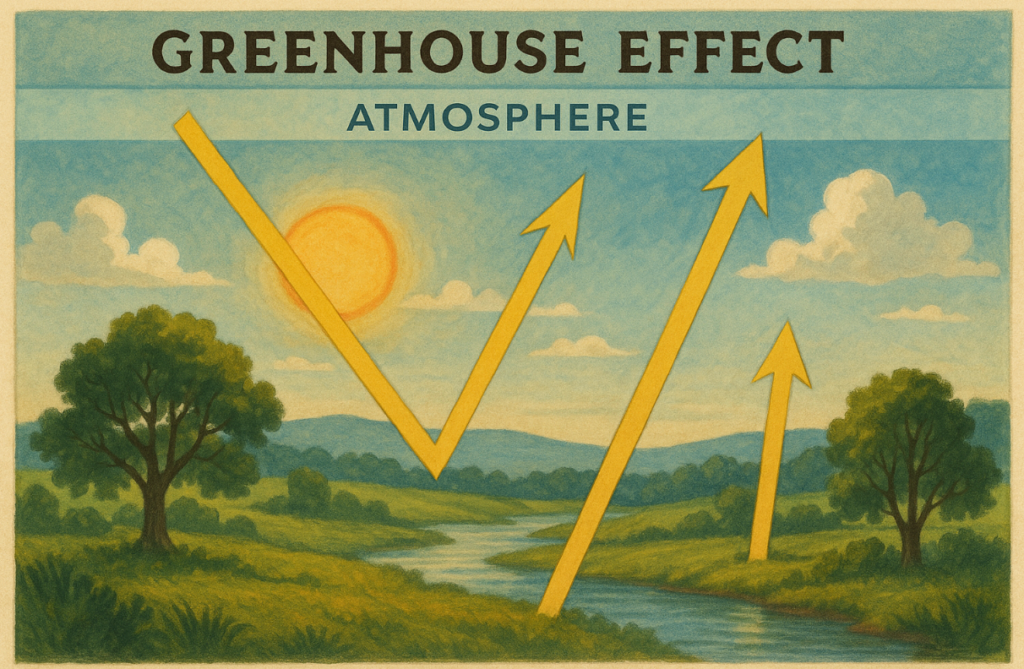
Now, some of that energy is emitted towards space, but some is emitted downward toward Earth’s surface. It is not that the atmosphere is magically creating energy to heat the surface; rather, this is energy that went into warming the atmosphere, which, since its temperature is above absolute zero, then emits that energy—some of it toward Earth’s surface. This energy can be kept in a loop, whereby energy is emitted by the surface, absorbed by the atmosphere, and in turn, emitted by the atmosphere and absorbed by the surface. Both Earth’s surface and its atmosphere are warmed by this energy loop, which we lovingly call the Greenhouse Effect.
The follow-up question is, “Why focus on just carbon dioxide? Since most of the atmosphere is nitrogen, oxygen, and argon, shouldn’t those molecules absorb and emit energy as well?”
The answer is … they do. All molecules absorb energy and emit energy if they are at a temperature above absolute zero. But different gases behave differently in that they absorb and emit energy in selective wavelengths.
Nitrogen, oxygen, and argon—which make up 99% of dry air—are different from water vapor, carbon dioxide, methane, ozone, nitrogen dioxide, and many of the other gases that make up the atmosphere. Nitrogen and oxygen are diatomic molecules; they contain just two atoms per molecule. Argon is a single atom; therefore, it is monatomic. All the others, including water vapor and carbon dioxide, are molecules containing at least three atoms. Thus, they have vibrational characteristics that monatomic and diatomic molecules lack. These vibrations often result in absorption and emission bands in the thermal infrared portion of the electromagnetic spectrum—heat, as we call it—whereas nitrogen, oxygen, and argon (and others) do not.
The short argument here is that molecules with three or more atoms can absorb and emit energy in the thermal infrared (heat) portion of the electromagnetic spectrum. If more energy is received than is given off based on the temperature of the molecule, the molecule will increase in temperature. Similarly, if more energy is given off than received, based on the temperature of the molecule, the molecule will cool. But with gases in the atmosphere, the absorption and emission lies within select wavelengths.
The second argument is that climatologists are idiots who cannot understand the basic laws of physics, such as the First and Second Laws of Thermodynamics.
As a climatologist, I take umbrage at this argument and point out that climatologists existed before climate modeling and well before the discussion of global warming, or even global cooling, came into being.
But now, let’s debunk the argument. The rationale is that climatologists misuse the Stefan-Boltzmann Law—which dictates that the energy given off by an object or molecule in the atmosphere is proportional to the fourth power of its temperature. The argument is that the law is only applicable for a single source of electromagnetic radiation and that the emitter must be warmer than the emittee, or the target. If the emitter is colder than the target, it cannot possibly add any energy to the target—or so the argument goes.
The last statement is correct, but only in the aggregate. Remember that this is a two-way street; the target is also an emitter if it is at a temperature above absolute zero. The point is usually made by these proponents that in energy diagrams, more energy is emitted by the atmosphere and absorbed by the Earth’s surface than is received from the Sun. Yes, that is correct. But if you turned off the Sun, the atmosphere and Earth’s surface would slowly cool until they reached an equilibrium temperature of absolute zero. All the energy in this system originates from the Sun; it is just that some goes into heating the atmosphere, which, in turn, keeps Earth’s surface warmer than it would have been if the atmosphere were not present. That Earth’s surface receives more energy from the atmosphere than from the Sun is a testament to how efficient the climate system is at keeping Earth’s temperature at a level that makes life habitable. We can thank our Creator for that.
The final argument against greenhouse warming is that this is a conspiracy that began in 1845. The hoax was perpetuated when the physicist James Prescott Joule, for whom the unit of energy is named, produced a false definition of energy that has since corrupted the field of physics. Other big-name physicists have been in on this hoax, most notably Niels Bohr, Max Planck, Gottfried Liebniz, Johann Bernoulli, Gaspard-Gustave Coriolis, Lord Kelvin, and William Rankine, just to name a few. Even Einstein himself was in on the conspiracy. Somehow, they all knew that climate change would become a major scientific issue some one hundred fifty years in the future, so, they made sure that carbon dioxide as an evil gas was cooked into the immutable laws of physics. I love a conspiracy theory as much as the next person, but … well ….
So, let me reiterate my position.
I DO NOT believe that carbon dioxide, methane, or nitrous oxide are existential threats to the planet. Neither are they reasonable threats of any kind.
Let me also state for the record that I DO NOT believe that carbon dioxide is a pollutant. In fact, if all life on Earth ceased to exist, our atmosphere would lose all its oxygen content and the proportion of carbon dioxide in our atmosphere would increase above ninety-five percent. Note that, according to most reputable scientists, there is no substantial life on Mars or Venus and the atmosphere of our two closest planets are largely carbon dioxide—that of Mars is about 96 percent carbon dioxide, 2 percent argon, and 2 percent nitrogen, while the Venusian atmosphere consists of about 96.5 percent carbon dioxide and only 3.5 percent nitrogen.
Thus, technically speaking, oxygen in our atmosphere is a pollutant created by life on Earth, most notably plant life. We should be infinitely grateful for the presence of that pollutant in our atmosphere. And to the Creator of everything who saw to it that oxygen, carbon dioxide, and all other gases were included in our atmosphere in appropriate quantities.