The artificial intelligence revolution is leaving green electricity states behind. Network operators are choosing states with policies favorable for gas-fired power to support construction of new data centers. States that block data center construction or try to force firms to use wind and solar electricity will lose the economic benefits of the AI boom.
We are in the midst of an AI revolution on a scale that may exceed the internet revolution of twenty years ago. BNP Paribus estimates that AI will boost the US economy by more than 10% by 2034. Goldman Sachs forecasts that AI could raise the global GDP by 7% over the next decade, or about $7 trillion.
More than one thousand data centers are under construction all over the nation, filled with servers to run AI. More than 4,000 data centers are now operating, up 50% since June 2024. Data center construction spending now exceeds that for office building construction.
Amazon, Google, Microsoft, Meta, and Oracle, the five largest AI “hyperscalers,” will spend over $800 billion this year and over $1 trillion in 2027 on AI capital equipment and data centers. Total 2027 spending is projected to exceed US spending for national defense.
Data center installation can bring tremendous benefits to local communities. The $20 billion, 1.8 gigawatt, 795-acre, Joliet Technology Center was just approved in Joliet, Illinois. The project is a medium-sized center but will be the largest in Illinois to date, expected to provide 10,000 construction jobs and $2.1 billion in tax revenue over a 30-year period.
But Illinois wants to force data centers to source power from wind and solar generators. In 2021 the state passed the Climate & Equitable Jobs Act, which requires coal and gas power plants to close between 2030 and 2045. As a result, Hull Street Energy is shutting down two-thirds of its Elwood Energy gas-fired plant years before a 2030 deadline, putting it on flatbed trucks, and transporting it to Texas. The six gas turbines being moved can together generate up to 900 megawatts of power. The loss of most of the Elwood Energy plant and the demands of the new Joliet Technology Center mean a three-gigawatt reduction in the available power capacity in northern Illinois.
Operators strive to bring new data centers online in less than three years to meet rising AI demand. Nuclear plants typically need 10 years for startup. Wind and solar facilities cover wide areas of land, require two to three times as much transmission, and years for transmission approval and construction. Since on-site gas plants can be built quickly, gas has become the dominant power source for new data centers.
But because of the data center boom, gas turbines are now in short supply. Turbine orders doubled from 2024 to 2025, and prices increased by 50%. The lead time for turbines from the world’s top three suppliers, GE, Siemens, and Mitsubishi, has stretched out to five years. Elwood Energy took advantage of this shortage by moving turbines to Texas.
Gas power plant construction for data centers is exploding in Texas. According to the Global Energy Monitor, Texas has 11 gas power plants under construction, another 102 in preconstruction—acquiring land, permits, and contracts—and another 28 projects announced. The pipeline of gas power projects in Texas grew to 58 GW in 2025, more than the peak power demand in California. Texas is building more gas-fired power than the next seven states combined, most of these to power data centers.
But like Illinois, many renewable energy states continue to try to force data centers to use wind and solar sources. Currently, 24 states have net zero electricity targets by 2050.
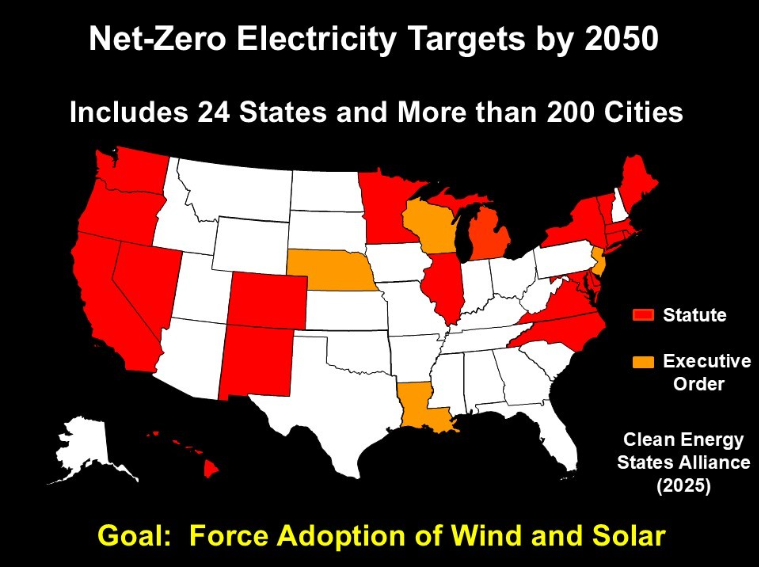
Data from USA Data Centers for the last two years shows that, with some exceptions, states without net zero electricity mandates are building data centers at a much faster pace than states with mandates. Since June of 2024, construction in states without mandates has exploded. Examples are Georgia (130 new data centers, up 157% from the number of existing centers), Indiana (84 new centers, up 221%), Iowa (73 new centers, up 252%), Missouri (33 new centers, up 85%), Pennsylvania (59 new centers, up 88%), and Texas (206 new centers, up 81%).
Most states with net zero mandates are building data centers at a much slower pace over the last two years. Examples are California (20 new centers, up 8%), Colorado (1 new center, up 2%), New York (6 new centers, up 5%), and Massachusetts (zero new data centers). Electricity prices in California, Massachusetts, and New York are amongst the highest in the nation, an additional reason why operators prefer other states for center sites.
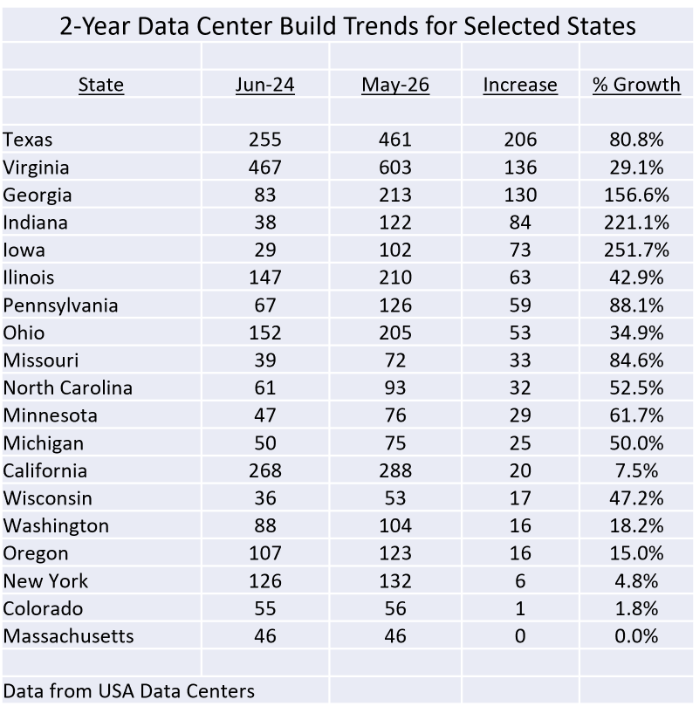
Two exception states with net zero power mandates are Illinois (63 new centers, up 43%), and Virginia (136 new centers, up 29%). Electricity prices in Illinois are just over the national average and Virginia prices are below the average, helping to attract developers.
In addition to energy mandates, several states are considering bans on data center construction. Ten states have introduced legislation for a moratorium on data center construction, including Illinois, Maine, Maryland, Michigan, Minnesota, New Hampshire, New York, Vermont, Virginia, and Wisconsin. Passage of these bills failed in New Hampshire and Wisconsin, and Maine governor Janet Mills recently vetoed a moratorium bill. No state has yet enacted such a ban.
Georgia, Oklahoma, Pennsylvania, South Carolina, and South Dakota, states that do not have green electricity mandates, are also considering legislation to halt data center construction. Legislation requiring hyperscalers to build their own onsite power plants and to minimize water usage can be sensible policy. But outright bans will leave states behind.
Last month, Senator Bernie Sanders introduced the “Artificial Intelligence Data Center Moratorium Act” in the Senate, intending to halt construction of data centers. Representative Ocasio-Cortez plans to introduce a companion bill in the House of Representatives. But these bills are unlikely to pass and, even if passed, are likely to be vetoed by President Trump.
If some states ban construction, hyperscalers will shift to states that will accept data centers and onsite gas power plants. Like Elwood Energy in Illinois, look for companies to close gas plants in green energy states and relocate them to other states with favorable policies. States should rescind their green electricity mandates or expect to be left out of the artificial intelligence revolution.
This article first appeared in MasterResource and has been republished here with permission.
Steve Goreham is a speaker on artificial intelligence, energy, the environment, and public policy, and author of four books, including Green Breakdown: The Coming Renewable Energy Failure.