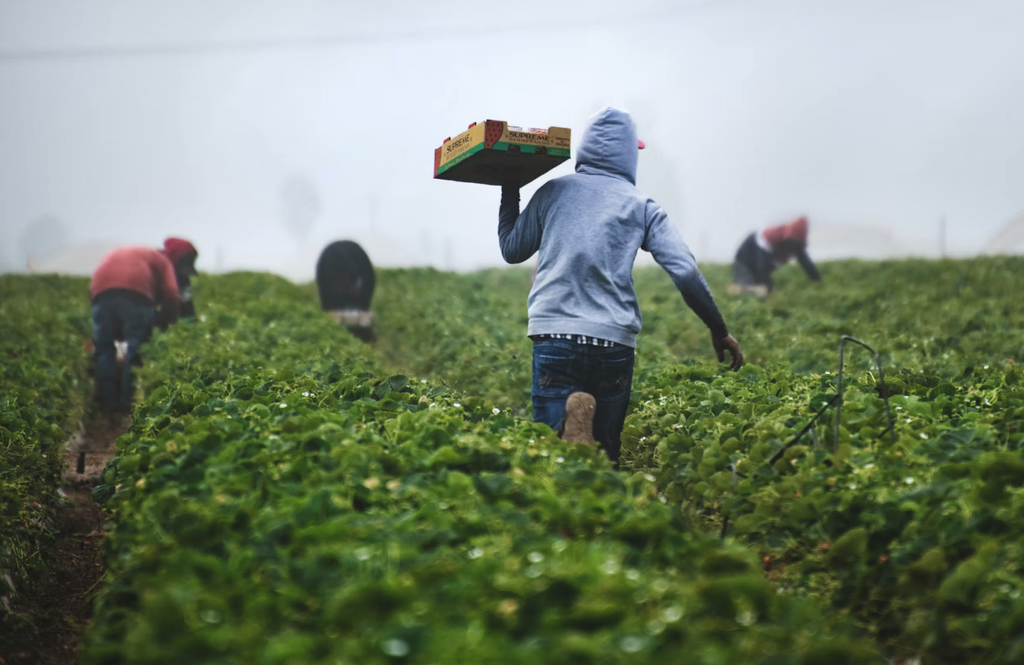
Is conventional agriculture incompatible with the Christian worldview? Is it possible to glorify God as a conventional farmer? Or must one embrace regenerative or some other agricultural method?
I’m going to reply to a question sent to us by a farmer whose work has been challenged by fellow Christians as incompatible with the Christian worldview.
“I am a dedicated Christian working in conventional agriculture,” he wrote, “specifically large-scale poultry farming.
“I often struggle with feeling demoralized in my career, as much of the current Christian literature on this topic favors small-scale regenerative or agrarian models. It frequently feels as though conventional agriculture is viewed as incompatible with a Christian worldview.
“Ultimately it comes down to: Can I glorify God in my current career? Am I stewarding God’s creation well in what I’m doing? Much of what I read and hear from fellow Christians suggests my career is incompatible with my faith and that I am not stewarding God’s creation well.
“I have searched for resources from a Christian perspective that support or validate conventional agriculture, but I have found very few.
“Could you recommend any Christian resources or publications that examine this topic in depth and offer a balanced or supportive perspective on conventional agriculture?”
You can feel the angst of this farmer. His vocation, his livelihood, no doubt the work he loves to do, is being challenged as poor stewardship of God’s creation. Worse, the challenge is coming from fellow Christians.
Here, with a few minor edits to make it suitable to an audio podcast, is how I answered him:
“Thank you for reaching out with a fascinating and truly important question.
“Let me begin in the simplest way I can imagine: Conventional agriculture raises roughly 99% of the world’s food supply; other methods, including regenerative, roughly 1%. (But beware: there’s no definition of regenerative agriculture that is widely embraced and used by any official bodies. And for an answer to the related but not identical question, ‘What percent of the world’s population is fed primarily by conventional agriculture and what percent by regenerative agriculture as generally understood in the contemporary movement recommending it?’, see an interchange I had with Perplexity AI, reproduced below. That interchange provides important qualifications to the figures and explains why no clean division between conventional and regenerative agriculture exists.)
“That ratio doesn’t entail a strict ratio of persons fed by conventional agriculture versus persons fed by regenerative and other methods of agriculture, but it’s highly unlikely to be far lower than 95-to-5. In short, you’re helping feed far more people than regenerative farmers. That, my friend, is laudable. God bless you!
“Now let me move in a bit more complicated direction. Thomas Sowell, one of the world’s leading (and one of my most respected) economists has often said, ‘There are no solutions, there are only tradeoffs.’ That holds for farming as it does for everything else.
“One must ask, of every farming method, ‘What are the tradeoffs?’
“In this case, the question refines to ‘What are the comparative costs and benefits of conventional farming versus regenerative and other farming methods?’ The costs are measured in what economists sum up as ‘land, capital, and labor,’ in which
- land includes material resources such as land, seed, breeder livestock, fertilizer, pest control, weed control, disease control, water, etc., as inputs, and pollution as a negative output;
- capital includes tools, machinery, and money;
- and labor includes the human labor hours exclusively dedicated to raising the food, plus the fraction of human labor in other vocations that contribute to food production.
“Those costs must be compared with the benefits (food produced, human beings fed), and the performance of conventional and other methods of agriculture (including regenerative) must then be compared.
“The answer is pretty clear from the data I’ve already presented, combined with the fact that very few people prefer a lower-profit (or absolute-loss) versus a higher-profit method of farming.
“‘Regenerative agriculture,’ by whatever definition, is a popular movement, and many Christians embrace it, though I’d say without careful analysis of all the pros and cons.
“Its ‘core theme,’ as gathered from a literature search by Perplexity AI, is that ‘farming should restore and improve the productive ecological base of agriculture—especially soil—rather than merely reduce damage or sustain current output.’ My only change to that would be that farming should restore and improve, or at least minimize the reduction of, the productive ecological base of agriculture.’ In some historical settings, it’s not hard to imagine that the best real option for a given farmer with a given piece of land is to minimize the rate of reduction of productive ecological base for a period, in hopes that changing conditions will allow a switch to increasing the productive ecological base later.
“And every farmer, conventional or otherwise, recognizes that, because every farmer knows that the quality of his land is essential to the quantity and quality, and hence the monetary value, of his product.
“The question, though, is how to achieve that end, and again, we must pay attention to tradeoffs. Take biological nutrient cycling, one principle favored by advocates of regenerative agriculture. It isn’t the only way to improve soil function and nutrient-use efficiency; synthetic fertilizer can contribute to that, too. The same can be said of various other principles of regenerative agriculture.
“The question is, ‘Which method yields the best ratio of benefits over costs for this piece of land for this farmer with these constraints?’ The answer to that will vary from one combination of land and farmer and constraints, to another combination of land and farmer and constraints.
“As for resources that validate conventional agriculture (which doesn’t mean saying it’s perfect or that no insights from other methods can improve it), let me recommend that you be in touch with the Fellowship of Christian Farmers International, the executive director of which, Dan Janzen, is a friend of mine and adviser to the Cornwall Alliance. As a former agricultural missionary to South Sudan as well as an accomplished member of a multi-generational farming family in America, Dan is deeply familiar with these matters.
“Can you glorify God in your current career? Certainly! Can you improve your farming methods? Most likely—I doubt you think yours are perfect, or even that you perform them as well as you wish you did.
“Welcome to the family of God—sinners saved by grace!”
So, that was my reply to this farmer’s question. I’m glad he asked, because it gave me an opportunity not only to minister to his own uncertainties about his vocation but also because it gave me an opportunity to address the issue here on Sanity Check.
As I said, we’ll post the contents of my Perplexity AI interchange about conventional versus regenerative agriculture below.
Dr. Beisner’s Perplexity AI Interchange About Conventional and Regenerative Agriculture
What percent of the world’s population is fed primarily by conventional agriculture and what percent by regenerative agriculture as generally understood in the contemporary movement recommending it?
There is no defensible global percentage of people fed by “regenerative agriculture,” because the movement has no universally accepted definition, no global registry of regenerative farms, and no worldwide accounting of the food they produce. The most responsible answer is therefore:
- Conventional agriculture: roughly 99% of the world’s food supply by a commonly cited broad definition—non-organically certified farming, typically using synthetic fertilizers and crop-protection chemicals. This is a food-supply estimate, not a precise count of distinct people fed. MDPI
- Regenerative agriculture, in the contemporary movement’s usual sense: unknown, but almost certainly a small minority—probably well under a few percent of the global population’s food supply if “regenerative” means verified whole-system regenerative management. No credible global estimate translates regenerative production into a share of people fed. The literature explicitly notes the lack of a standardized definition and corresponding measurement system. Frontiers MDPI
Why No Clean Split Exists
The question sounds like it should yield two complementary numbers—e.g., 95% conventional and 5% regenerative—but the categories do not work that way.
“Conventional agriculture” is generally used as a residual category: farming that is not certified organic and that commonly relies on synthetic fertilizers, pesticides, herbicides, improved crop varieties, mechanization, irrigation, and other modern inputs. By that broad definition, one review cites conventional farming as providing 98.9% of the world’s food. MDPI
“Regenerative agriculture,” however, is a movement and set of principles, not a consistently regulated production category. It commonly emphasizes soil health, reduced disturbance, cover crops, crop diversity, integrated livestock, reduced chemical dependence, biodiversity, water retention, and sometimes measured outcomes such as soil-carbon gains or improved ecosystem function. But neither governments nor international agencies apply one uniform threshold worldwide. Frontiers Springer
A farm can, for example:
- Use no-till and cover crops but still use synthetic nitrogen and herbicides.
- Be certified organic without meeting a particular regenerative standard.
- Be regenerative by a corporate or NGO framework but not by another organization’s definition.
- Use long-standing traditional or agroecological methods that resemble regenerative practice without using the label “regenerative.”
So “regenerative” overlaps with organic, conservation agriculture, agroecology, pasture-based livestock systems, and some conventional farms. It is not the opposite of conventional in a way that allows a clean population split.
Useful Benchmarks
The closest measurable category is certified organic, but organic is not synonymous with regenerative agriculture.
| Measurable indicator | Latest/commonly cited figure | What it can and cannot tell us |
|---|---|---|
| Conventional/non-organic agriculture’s share of global food | About 98.9% | A broad estimate of world food output; it does not identify every farming practice used. MDPI |
| Certified organic farmland | 2.1% of global agricultural land in 2023 (98.9 million hectares) | Organic land share, not food share or people fed; much organic area is grazing land, and yields/crop mixes differ. FiBL Orgprints |
| Global organic cereal area | 0.8% of global cereal area in 2023 | A more relevant proxy for staple-calorie production, though still not a measure of regenerative food. Orgprints |
| Regenerative agriculture | No globally accepted adoption or food-output statistic | The category lacks a standardized definition, metrics, and global census. Frontiers MDPI |
Even the 2.1% organic-land figure should not be converted directly into “2.1% of people are fed organically.” Land productivity, crop types, grazing, trade, food waste, animal feed, and diets differ too much for that inference. The fact that more than two-thirds of global certified organic land is grassland/grazing land makes the land-to-calorie conversion especially misleading. Orgprints
A More Precise Way to State It
For a report, article, or discussion, I would phrase the conclusion this way:
Nearly all food in the present global food system is produced within broadly conventional, non-organic agriculture. Regenerative agriculture is growing but remains impossible to quantify globally as a share of people fed, because it lacks a uniform definition and worldwide reporting system. Certified organic farming—the closest independently tracked but imperfect proxy—occupied 2.1% of global agricultural land in 2023, while only 0.8% of global cereal area was organic.
That avoids two opposite errors:
- Overstating conventional agriculture’s exclusivity: Many farms categorized as conventional use one or more soil-conserving or regenerative-style practices.
- Overstating regenerative agriculture’s present scale: Claims that regenerative or traditional smallholder systems “feed 70% of the world” typically rely on much broader, contested categories—smallholder, family, peasant, local, agroecological, or traditional farming—not on the contemporary, outcome-oriented regenerative-agriculture category. Ellen MacArthur Foundation ETC Group
Important Qualification on Fertilizer
If the underlying question is really about the dependence of today’s population on modern industrial agriculture, synthetic nitrogen offers a more defensible benchmark: major estimates converge around 40–50% of the world’s population being supported by food production dependent on synthetic nitrogen fertilizer. That does not mean the remaining half is fed regeneratively; it means food systems are mixed, and the counterfactual is difficult to calculate. Our World in Data
So the short answer is: about 99% conventionally in the broad non-organic sense; no valid worldwide percentage for regenerative agriculture, but its strictly defined and verifiable share is presently small rather than a major fraction of humanity’s food supply.
What Is the Core Theme of Regenerative Agriculture?
The core theme of regenerative agriculture is that farming should restore and improve the productive ecological base of agriculture—especially soil—rather than merely reduce damage or sustain current output.
The core theme of regenerative agriculture is that farming should restore and improve the productive ecological base of agriculture—especially soil—rather than merely reduce damage or sustain current output. Its leading advocates generally unite around soil health, biological diversity, resilient farm ecosystems, and viable farm livelihoods, but they differ sharply over whether synthetic fertilizers, herbicides, pesticides, biotechnology, and animal agriculture can have a place in a regenerative system. PMC Congressional Research Service
The Core Idea
The term “regenerative agriculture” was prominently articulated by Robert Rodale in the early 1980s. His formulation was ambitious: a regenerative system should raise productivity while increasing the land’s biological productive capacity, improve economic and biological stability, minimize off-farm harm, and lessen dependence on nonrenewable inputs. PMC Congressional Research Service
In contemporary usage, advocates often distinguish three ambitions:
- Sustainable agriculture: avoid making conditions worse.
- Regenerative agriculture: leave the land, soil, water cycle, biodiversity, and often the community in better condition.
- Extractive or degenerative agriculture: draw down soil organic matter, erode land, simplify ecosystems, and rely heavily on externally purchased inputs.
The distinction is more rhetorical than scientifically standardized, but it explains why the movement emphasizes outcomes—better soil function, more biological activity, greater resilience—not simply a fixed list of approved inputs. Congressional Research Service Frontiers
Widely Shared Principles
The following principles are the closest thing to a common regenerative-agriculture platform. They appear, in closely related forms, in U.S. conservation guidance, regenerative standards, advocacy organizations, corporate programs, and scholarly reviews. Congressional Research Service IFC EarthDay.org
| Principle | Basic meaning | Common practices |
|---|---|---|
| Build living soil | Treat soil as a living ecosystem, not merely a physical medium to hold plants and added nutrients | Compost, manure, diverse residues, reduced compaction, attention to soil organic matter, microbes, fungi, and earthworms |
| Minimize soil disturbance | Avoid unnecessary disruption of soil structure and biology | No-till or reduced tillage, strip tillage, controlled traffic, less intensive cultivation |
| Keep soil covered | Protect soil from rain impact, erosion, temperature extremes, and loss of moisture | Cover crops, crop residues, mulch, living groundcover |
| Maintain living roots | Keep plants growing as much of the year as climate and crop systems permit, so roots feed soil organisms and retain nutrients | Cover crops, relay crops, perennial crops, extended rotations |
| Increase diversity | Replace simplified monocultures with more biologically diverse systems above and below ground | Diverse crop rotations, multi-species cover crops, intercropping, hedgerows, agroforestry, pollinator habitat |
| Recycle nutrients biologically | Shift nutrient cycling toward legumes, manure, compost, crop residues, and biological processes | Legume rotations, green manures, composting, managed livestock, biological nitrogen fixation |
| Integrate animals appropriately | Reconnect grazing animals to land and nutrient cycles, especially in pasture systems | Adaptive or rotational grazing, silvopasture, manure management, crop-livestock integration |
| Improve water function | Increase infiltration, water-holding capacity, and resistance to drought or heavy rain | Ground cover, soil organic matter, less compaction, perennial vegetation, contour practices |
| Promote biodiversity | Build habitat and ecological interactions that can contribute to pest control, pollination, soil fertility, and resilience | Crop diversity, reduced broad-spectrum pesticide use, habitat margins, agroforestry |
| Protect profitability and livelihoods | Make farms durable economically, not only environmentally | Lower purchased-input exposure, diversified enterprises, risk management, premium markets, local or regional marketing where appropriate |
The compact version often used by agricultural agencies and regenerative programs is: minimize disturbance; keep the soil covered; keep living roots in the ground; maximize biological diversity; and integrate livestock where appropriate. Congressional Research Service IFC
Major Themes Beyond Soil
1. Soil Health Is the Organizing Principle
The movement commonly treats soil organic matter, soil aggregation, microbial activity, nutrient cycling, and root systems as the foundation of farming. Healthy soil is expected to infiltrate water better, resist erosion, cycle nutrients more effectively, and buffer crops against dry spells and intense rain. PMC EarthDay.org
This is why practices such as cover crops, reduced tillage, diverse rotations, compost, and grazing appear so consistently. They are not ends in themselves; they are supposed to improve the function of the soil ecosystem.
2. Farming Should Rely More on Biology and Less on Purchased Inputs
Many leading proponents frame regenerative agriculture as a transition from external-input dependence toward biological processes:
- Nitrogen supplied partly through legumes and biological fixation.
- Fertility supported by organic matter, crop residues, manure, and nutrient cycling.
- Pest pressure reduced through diversity and ecological controls.
- Water use improved by deeper roots, cover, and soil structure.
Robert Rodale’s original version was comparatively strong: it called for food free of biocides, avoidance of synthetic fertilizers that disrupt biological structure, biological nitrogen fixation, and livestock systems avoiding routine hormones and prophylactic antibiotics. PMC Congressional Research Service
Contemporary regenerative agriculture contains a much broader coalition. Some advocates retain that organic-oriented view; others permit carefully targeted synthetic inputs during a transition or as one tool among many. That disagreement is central, not incidental.
3. Diversity Replaces Simplified Monoculture
Regenerative advocates tend to see monoculture—not merely chemical use—as a basic structural problem. A field planted continuously in a single crop may be efficient in narrow operational terms, but it can concentrate pest risks, reduce habitat, narrow root diversity, and create dependence on purchased fertility and pest-control inputs.
The proposed alternative is not necessarily abandoning commodity crops. It is usually a more diverse system around them:
- Longer and more varied rotations.
- Cover-crop mixtures rather than bare fallow.
- Legumes alongside grain crops.
- Perennials, trees, hedgerows, or buffers in appropriate places.
- Integration of grazing animals where economically and ecologically suitable.
Scholarly summaries consistently identify crop diversity, rotations, cover crops, agroforestry, and livestock integration as principal regenerative tools. PMC Congressional Research Service
4. Livestock Can Be Ecological Partners—Under One Major School
A prominent strand of the movement, associated especially with holistic-management and adaptive-grazing advocates, argues that well-managed ruminants can stimulate grassland growth, return nutrients through manure, maintain ground cover, and help rebuild soil carbon and water infiltration. Rotational or “managed” grazing is therefore a flagship practice for many regenerative ranchers. PMC EarthDay.org
This does not mean all regenerative advocates regard more livestock production as desirable. Plant-centered and agroecological proponents may emphasize legumes, compost, rotations, and perennial plant systems while questioning the land, methane, feed, welfare, or resource implications of livestock expansion. The shared principle is better nutrient cycling and land stewardship; the role and scale of animals are contested.
5. Climate and Carbon Are Important, but Not the Whole Case
Many public advocates present regenerative agriculture as a climate strategy: plants capture atmospheric carbon through photosynthesis, and some of that carbon may be retained as soil organic matter when management improves. Advocates also stress that healthier soil can hold more water and become more resilient to drought and flooding. EarthDay.org
More careful versions of the argument make several qualifications:
- Soil-carbon gains vary greatly by soil type, climate, starting condition, crop system, and management.
- Carbon gains can slow as soils approach a new equilibrium.
- Soil carbon can be lost again if practices change or land is disturbed.
- Climate benefits must be considered alongside nitrous oxide, methane, fuel use, fertilizer manufacture, land-use change, and yields.
Thus, a serious description treats carbon sequestration as a possible co-benefit and outcome to measure, not an automatic result of calling a farm regenerative.
6. Food Quality, Health, and Community Often Enter the Vision
For movement leaders, regenerative agriculture often reaches beyond field agronomy. They connect land health with:
- Nutrient density and food quality.
- Reduced exposure to certain pesticides or other agricultural chemicals.
- Farm-worker and animal welfare.
- Family-farm viability and local ownership.
- Rural employment and community resilience.
- Indigenous, traditional, and place-based knowledge.
- Fairer food systems and supply chains.
These social themes are prominent in some regenerative standards and advocacy networks, although they are less uniformly defined or measured than soil practices. The Congressional Research Service likewise notes that regenerative agriculture can encompass environmental, economic, and social-welfare objectives, not merely soil-management techniques. Congressional Research Service Congressional Research Service
The Main Fault Lines
“Regenerative agriculture” is not a single doctrine. It is best understood as a coalition built around overlapping concerns rather than a settled technical category.
| Question | More input-permissive view | Organic/regenerative view |
|---|---|---|
| Synthetic fertilizer | May be used strategically while improving soil function and nutrient-use efficiency | Should be substantially reduced or eliminated in favor of biological nutrient cycling |
| Herbicides and pesticides | May be retained, often in reduced or targeted form, especially during no-till transitions | Should be phased out or prohibited; biodiversity should replace chemical dependence as much as possible |
| No-till | Often central, even where herbicides are used | Valuable only if not dependent on routine herbicide use |
| Genetic engineering | May be compatible if it advances resilience, reduces inputs, or raises yields | Often rejected, especially by organic-oriented advocates |
| Livestock | Important in many systems but optional and context-dependent | Usually valued when integrated humanely and ecologically; some plant-centered advocates remain skeptical |
| Certification | Outcomes and continuous improvement may matter more than a single universal rulebook | Strong standards and third-party certification are needed to prevent vague or misleading claims |
The U.S. Congressional Research Service captures the practical ambiguity: many initiatives emphasize reduced tillage, cover crops, rotations, livestock integration, and reduced external inputs, while definitions and labeling systems differ substantially. Congressional Research Service Congressional Research Service
What It Means in Practice
A conventional corn–soybean operation does not become regenerative merely by adding one cover crop, nor does a certified organic farm automatically meet every regenerative ideal. The movement usually asks whether the whole system is moving in a regenerative direction.
For example, a Midwestern grain farm moving toward a regenerative model might:
- Replace repeated intensive tillage with reduced tillage or no-till where agronomically workable.
- Add winter cover crops—such as cereal rye, clover, radish, or multi-species mixtures—to avoid bare soil.
- Lengthen a corn–soy rotation with small grains, forage legumes, or other crops.
- Use soil tests and field observations to reduce nutrient losses and improve nutrient-use efficiency.
- Add managed grazing of cover crops where fencing, water, timing, labor, and markets make that feasible.
- Track outcomes: erosion, infiltration, soil organic matter, nutrient losses, yields, net returns, drought performance, and biodiversity indicators.
That illustrates a crucial point: regenerative agriculture is more coherently described as a direction of travel and a system of measurable outcomes than as a single production recipe.
Its strongest common claim is not “every farm must use exactly these inputs or practices.” It is: Agriculture should increase the capacity of land and farm communities to keep producing—biologically, hydrologically, economically, and socially—rather than consuming that capacity over time.