It’s hurricane season again, and a few things about it are as certain as death and taxes. First, some named storms, tropical storms, hurricanes, and cyclones will form somewhere, sometime, in the Atlantic and Pacific oceans. Second, one or more of those storms will cause some degree of damage in some country or another. Third, at one point or another during the hurricane season, some media outlet, mainstream or social media only, will claim one or more hurricanes were caused by or made more likely by climate change.
That last claim is patently false. Even the U.N. Intergovernmental Panel on Climate Change says it has been unable to find a measurable change in hurricane frequency or severity that it can tie to human greenhouse gas emissions. Despite that, people will make that claim, probably backed up by a dubious, quickly thrown-together attribution study.
The National Oceanic and Atmospheric Administration (NOAA), the keeper of all official data and annual prognostications on hurricanes, has predicted a “below-normal 2026 Atlantic hurricane season.”
Specifically, NOAA forecasts that during the 2026 hurricane season, which runs from June 1 through November 30, there is:
- a 35 percent chance of a near-normal season;
- a 10% chance of an above-normal season, and;
- a 55% chance of a below-normal season.
Delving further, NOAA forecasts:
- a total of eight to 14 named storms (winds of 39 mph or higher);
- three to six of those storms to reach hurricane-strength winds of 74 mph or higher); and
- one to three of those hurricanes to have wind speeds of 111 mph or higher, making them “major” storms of category three, four, or five.
Rational people will hope and pray NOAA is right and we have a below-normal hurricane season and, as importantly, that as with 2025 no storms make landfall. Still, people in or near hurricane-prone areas should be prepared for even minor storms and for NOAA’s forecast to prove overly optimistic.
It’s not rare for NOAA to have to adjust its outlook up or down mid-season. My colleague Anthony Watts noted that since the inception of NOAA’s May Hurricane Forecast, the actual number of named storms fell within the forecast range in 16 out of 26 years, a forecast success rate of approximately 62 percent. NOAA’s preseason forecast success rate for hurricanes is about 58 percent. (See the chart below.)
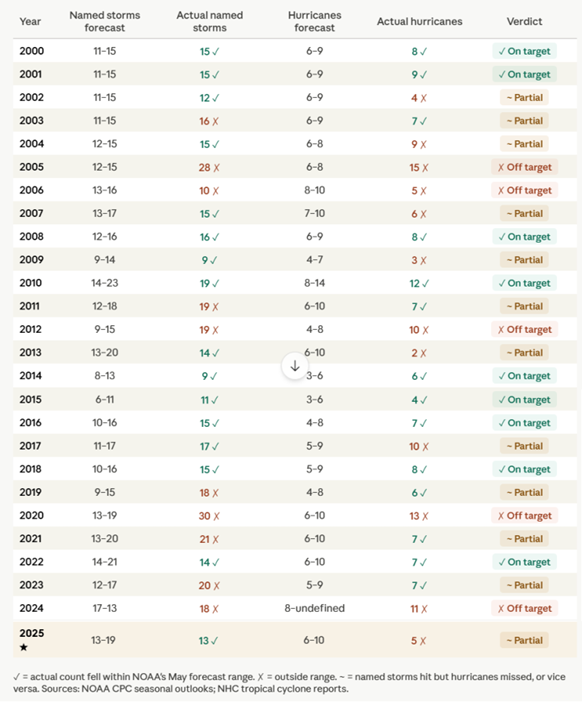
The much more dangerous underestimate was more common in NOAA’s forecasting failures than overestimating storms.
Since Atlantic tropical storms and hurricanes can affect the United States, my Heartland Institute colleagues and I pay more attention to the Atlantic Hurricane numbers than those for the Western North Pacific region. Still, climate change is a global phenomenon, so it is important to see if the “no real change” in hurricane frequency or intensity the Atlantic has experienced is similar to what other hurricane basins are seeing.
A new study published in the journal Natural Hazards examined the intensity of landfalling tropical cyclones in nations bordering the Western North Pacific, with the hope of identifying patterns tied to large-scale oceanic currents/systems. The researchers found “[l]andfall trends over individual nations are insignificant, but significant decreases are noted for the northern Philippines and parts of Micronesia, including for intense [major cyclones].”
By contrast, the southwest corner of Japan has experienced a more modest increase in intense landfalling hurricanes, although statistically the change is not considered robust.
In the end, the IPCC hasn’t detected discernible changes in global tropical storm frequency or intensity during the recent period of slight warming, and it makes no claims of any impact of human emissions on hurricane numbers or strength. And the IPCC isn’t an outlier. Data from different hurricane basins show no consistent sustained trends in hurricane formation or strength. Remember this as the 2026 hurricane season blows through and garners headlines: whether it is a devastating season or a mild one, climate change has nothing to do with it. Don’t let the media or attribution-study shills tell you otherwise.
This piece originally appeared at Heartland.org and has been republished here with permission.